What is raw milk? What you need to know about raw milk in Yorkshire
Raw milk has quietly built a following across Yorkshire over the past few years — farm shops mention it, farmers' markets sell it by the bottle, and a fair number of people swear it tastes noticeably different from anything on a supermarket shelf.
Less understood is what actually separates it from ordinary milk, what the real risks are, and where UK law allows it to be sold at all.
This guide sets out the basics in plain terms: what raw milk is, the benefits people claim for it, the genuine risks worth knowing before you buy, and what to look for in a supplier if you decide it's for you.
What is raw milk, exactly?
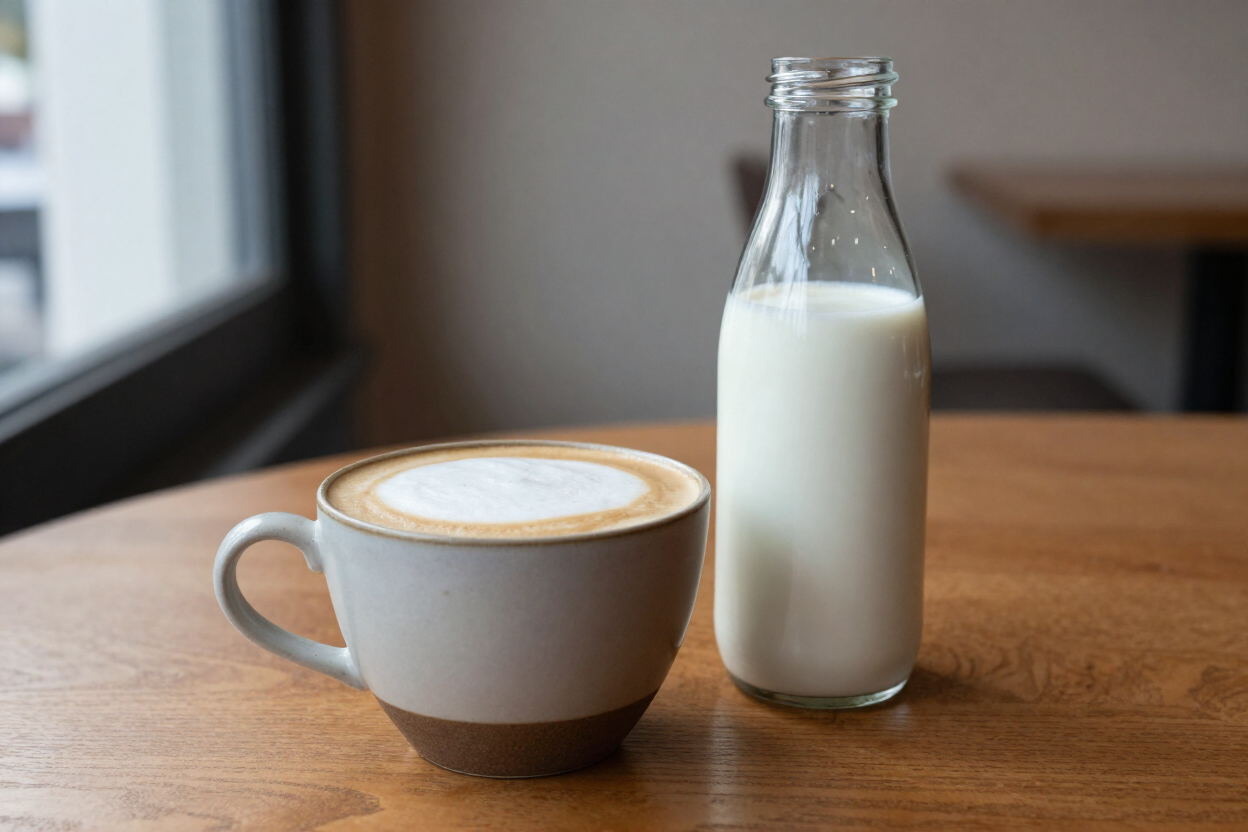
Raw milk is milk that hasn't been pasteurised — it goes straight from the animal to the bottle without the heat treatment that kills off harmful bacteria along with a small amount of flavour and a handful of heat-sensitive nutrients.
Most of what's sold in UK shops, including everything in Elmfield's milk range, is pasteurised: heated briefly to a set temperature and cooled quickly, a process that's been standard practice for the better part of a century precisely because it makes milk dramatically safer without changing it very much.
Raw milk skips that step entirely, which is exactly why its supporters and its critics disagree so sharply about it.
Claimed benefits of raw milk
People who seek out raw milk usually point to a handful of things: a richer, creamier taste that many describe as closer to how milk used to taste before large-scale processing; a belief that heat-sensitive enzymes and some vitamins survive better without pasteurisation; and, for a good number of buyers, a simple preference for supporting a small, local farm directly rather than a distribution chain.
There's genuine substance to some of this — flavour is subjective but real, and buying direct from a farm gate does put money straight into a local business. Where the science gets murkier is health.
The Food Standards Agency doesn't recognise raw milk as offering a proven health advantage over pasteurised milk, and most of the claims around gut health or allergy prevention haven't held up well under proper study.
Anyone weighing it up is better off treating the health claims as unproven rather than as an established fact, while still recognising that taste and provenance are legitimate reasons some people prefer it.
The real risks — and who should avoid raw milk entirely
Because raw milk never goes through pasteurisation, it carries a meaningfully higher risk of harbouring bacteria that cause food poisoning — E. coli, Listeria, Salmonella, and Campylobacter are the ones that show up most often in outbreak reports. Healthy adults who catch one of these usually recover, if unpleasantly, but the risk is not spread evenly across everyone, and current guidance is specific about who should steer clear altogether:
- People aged 65 or over, whose immune response to foodborne bacteria tends to be weaker.
- People who are pregnant, since certain infections carry serious risks for an unborn baby.
- Anyone who is immunocompromised, including people undergoing certain medical treatments.
- Infants and young children, who are more vulnerable to severe complications from food poisoning than adults.
If you fall into any of these groups, the honest advice — from public health guidance and from most dairy professionals — is to stick with pasteurised milk, however good the raw version at the local farm shop is supposed to be.
For everyone else, the risk is lower but not zero, and it's worth treating raw milk the way you'd treat any unpasteurised food: store it properly, use it promptly, and don't assume a trusted-looking farm automatically means a risk-free product.
Is raw milk legal in Yorkshire?
Selling raw cow's drinking milk is legal in England — Yorkshire included — but only within narrow limits, and it's worth understanding exactly what those limits are before assuming any bottle labelled 'raw' has been checked properly. To sell legally, a farm must meet several conditions:
- Be registered specifically as a raw drinking milk production farm with the Food Standards Agency.
- Keep a herd that's certified free of tuberculosis and brucellosis.
- Sell only directly to the consumer — at the farm gate, through the farm's own vending machine or online shop, or via its own farmhouse catering operation.
- Submit to hygiene inspection by FSA dairy hygiene inspectors twice a year, alongside routine testing of the milk.
Selling raw milk through any other channel — a shop, a market stall run by someone other than the farmer, or a restaurant sourcing it from a third party — is illegal, which is worth knowing if you come across it somewhere that doesn't fit this description. Scotland takes a stricter line altogether, having banned the sale of raw milk and raw cream outright since the 1980s, so the rules genuinely change once you cross the border.
How to choose a raw milk supplier
If you've decided raw milk is worth trying, a bit of due diligence before you buy makes a real difference to how safe that decision actually is. A few things worth checking with any supplier:
- Confirm the farm is registered with the Food Standards Agency for raw drinking milk sales — this isn't optional, and a legitimate seller should have no trouble confirming it.
- Ask whether the herd is tested and certified free of tuberculosis and brucellosis, and how often that testing happens.
- Check that the milk carries a clear warning label stating it's unpasteurised and may contain harmful bacteria — its absence is a red flag, not a minor oversight.
- Look at how the milk is chilled and stored between milking and sale, since the cold chain matters as much for raw milk as the initial hygiene does.
- Buy only in quantities you'll use quickly, and ask the farm directly about their recommended shelf life rather than guessing.
A farm that answers these questions readily, without hesitation or vague reassurance, is generally the safer bet. One that brushes past them is worth avoiding, whatever the milk itself is meant to taste like.
Where pasteurised milk remains the practical choice
For most households, and for essentially all hospitality and catering businesses, pasteurised milk stays the more workable option — and not just for safety reasons.
Raw milk's legal sale routes are deliberately narrow: a pub, café, or care home can't simply add it to a supplier order the way they would ordinary milk, cream, or yoghurt, because current rules only allow direct farm-gate sales to the individual consumer.
That's precisely the gap a dairy supplier in Yorkshire like Elmfield Farm Dairies fills for businesses: fresh milk delivery that's pasteurised, traceable, and consistent from one drop to the next, arriving up to six days a week without a kitchen needing to think about herd testing or cold-chain compliance themselves.
For home cooking, the same logic applies on a smaller scale — pasteurised milk from a local farm milk supplier still supports Yorkshire farming and still tastes noticeably better than a shelf-stable supermarket carton, without asking the household to manage the extra care raw milk needs.
FAQs
Is raw milk safe to drink?
It carries a higher risk of foodborne illness than pasteurised milk, mainly from bacteria like E. coli, Listeria, and Campylobacter. Healthy adults who choose it should still buy only from a registered, well-run farm and store it properly; people aged 65 or over, pregnant, immunocompromised, or very young should avoid it altogether.
Can restaurants and cafés serve raw milk to customers?
Generally, no. Current rules only allow raw milk to be sold directly by the registered farm itself — at the farm gate, through its own vending machine, or via its own farmhouse catering — so a separate hospitality business can't buy it in and serve it the way it would ordinary dairy.
Does raw milk actually taste different?
Most people who drink both notice a difference — raw milk is often described as richer and creamier — though this comes down to personal taste rather than anything that can be measured as objectively 'better'.
How can I tell if a raw milk supplier is legitimate?
Check that the farm is registered with the Food Standards Agency, that the milk is clearly labelled as unpasteurised, and that the farm can speak confidently about herd testing and hygiene inspections. Vague or evasive answers are a reason to look elsewhere.
Summary and next step
Raw milk sits in an unusual spot: legal to buy in Yorkshire, genuinely popular with a loyal group of drinkers, and carrying real risks that pasteurisation was specifically invented to remove.
If you're curious, buying from a properly registered farm and understanding who should avoid it altogether covers most of what matters.
If what you actually need is dependable, food-safety-compliant milk delivered on a schedule — for a household or for a busy kitchen — Elmfield Farm Dairies has been supplying pasteurised milk, cream, butter, and yoghurt across Yorkshire for more than 40 years, with next-day delivery for orders placed online before 7:00 pm.
Get in touch to set up a regular drop, or browse the full milk range to see what would fit.
Blog